
GenAI and Agentic AI are going to be incredibly disruptive — but most organizations still don’t have a real strategy.
We see hackathons, proofs of concept, and isolated pilots everywhere – great for learning, but not enough to drive lasting competitive advantage. To truly win with GenAI, leaders need an integrated strategy that connects culture, skills, systems, structure, and shared values – not just new tools.
Using McKinsey’s 7S Framework as a lens, this article explores how GenAI and Agentic AI will reshape how organizations operate – from decision-making and team skills to data systems and org design.
It also shares five practical steps to move from experimentation to sustained business impact, ensuring your GenAI efforts are orchestrated, aligned, and built to scale.
GenAI success isn’t about demos…
It’s about building a unified, adaptable strategy that connects your people, processes, and purpose to the possibilities of intelligent automation.

Adopting GenAI is Today’s #1 Board Priority…
Leadership Teams around the world are asking similar questions about Generative AI:
- What does it mean for our business?
- How can we leverage it to drive increased performance?
- Can we adopt it without “giving away the keys to the kingdom”?
- Do we have the talent we need?
- How can we move faster?
GenAI and Agentic AI will fundamentally change the ways we run businesses, and there will be clear winners and losers in the process…
Lot's of Anxiety, Very Little Strategy...
Unfortunately, that aligned “call to action” has yet to translate to an integrated and actionable strategy in most organizations. We see lots of “Hackathons” and Proofs of Concept wherever we go, and they play an important role in engaging your teams and helping them “work up the GenAI Learning Curve”. They don’t, however, ensure your organization has a structured, deliberate plan to embed GenAI into your core ways of working.

Testing Your Organization or Group's GenAI Strategy
The good news? Testing if your organization actually has a GenAI strategy takes less than an hour – here’s how… Take a few minutes to ask different members of your team, at different levels of your organization,
“What is our GenAI Strategy”?
Not everyone will be able to answer that question succinctly, but you know you have an issue if:
- You get a blank stare as people scramble to think of something to say
- You get vastly different answers that don’t ladder up to a thematic strategy
- People start making stuff up and hope you don’t notice…
It may sound simple, but the simplest tests are often the most revealing. If your team members don’t understand your strategy or you haven’t actually defined one, you’re GenAI adoption efforts are going nowhere fast…
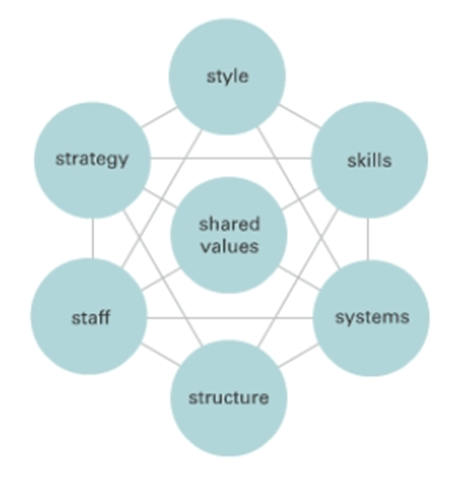
Leveraging McKinsey’s “7S” Strategy Framework to Assess Your GenAI Strategy
No model is perfect, but many are useful, and McKinsey’s 7s Strategy Framework is extraordinarily applicable for assessing your GenAI adoption plans – here’s why…
Style (typically referred to as Culture)
This refers to an organization’s cultural norms, approaches to decision making, and informal ways of working. An organization’s culture will play a key role in determining how effectively it navigates periods of tech-driven disruption.
- Are decisions made decisively or by committee?
- How tied to legacy ways of working is your organization or group?
- How effectively can your organization “pivot” when it needs to?
These are all factors that influence how effectively your organization responds to shifting competitive dynamics, like GenAI adoption, and evolves its ways of working.
Skills (including organizational Capabilities)
Adopting and scaling GenAI is fundamentally a Capability or “Skills” journey. You’ll need to evolve a wide range of existing organizational capabilities and adopt several new ones (think Natural Language Understanding, LLMOps, and Model Training & Fine Tuning).
The same applies to team member skill development. Traditional application developers will need to think more like Data Scientists as they build high-performing non-deterministic GenAI solutions. Data Scientists looking to build scalable GenAI solutions will need to work up the enterprise App Dev learning curve. Product Managers and Assurance Leads will need to understand GenAI at an applied, non-superficial level. And last, but not least, team members across your Ops functions (Marketing Ops, FinOps, Customer Support, etc.) will play a critical role in embedding GenAI and Agentic AI into your core ways of working.
- Are decisions made decisively or by committee?
- How tied to legacy ways of working is your organization or group?
- How effectively can your organization “pivot” when it needs to?
These are all factors that influence how effectively your organization responds to shifting competitive dynamics, like GenAI adoption, and evolves its ways of working.
Systems
We’re on the front end of a “Systems and Business Process” evolution…. Agentic AI will fundamentally transform the way organizations run their business over the coming years. To get there, though, organizations will need to codify implicit business logic, simplify and streamline their business processes, and implement very rigorous guardrails. The other sticking point is no one’s data is really “Ready” for autonomous Agents. There’s much to be done in this area before we’ll see significant bottom-line GenAI impact…
“Structure” GenAI’s implications for existing organizational structures are less clear today. AI may ‘flatten’ organizations, but customer-centric business units and specialized functions will remain essential. You’ll also need to break down organizational silos to realize its benefits.
A key “Structure” question that is relevant to every business is “Where should the AI/GenAI function be positioned within the company?”. In my opinion, there’s no single “right answer”… The cross-functional nature of adopting and scaling GenAI means wherever it sits, the accountable AI Exec will need to drive alignment across the full scope of the business. Two things that need to be non-negotiable from a structure perspective, though, are:
- AI & GenAI can not be seen simply as a Tech or IT priority… Adoption needs to be treated as a business imperative, and regardless of where formal leadership is positioned in the org, it needs to be approached cross-functionally.
- Adopting & Scaling AI Requires “Orchestration”… An “Accelerator” group needs to designed, staffed, and empowered to coordinate and enable the change.
Staff
This title is a little outdated, and reflects the 1970’s origin of the 7s model, but it’s no less important… It’s also the area that drives the most anxiety when adopting AI & GenAI. Put simply, folks are worried about GenAI rendering them irrelevant… If not proactively addressed, these (valid) concerns can create massive headwinds to successful adoption and significantly limit an organization’s GenAI impact.
The reality, though, is AI, GenAI, and Agentic AI will have meaningful implications for your workforce. What those implications will be will vary by industry and role, but they’re coming… You’ll want to take a deliberate approach to upskilling and strategic workforce planning to ensure you manage the change effectively.
Shared Values
The center of the 7s framework can be a bit abstract for many. Fundamentally, it reflects the fundamental “reason to be” for an organization. Are you a “For Profit” organization or a mission-driven group? What fundamental customer problems are looking to solve? What markets do you serve? What’s your Brand identity? These are core Values that have broad-based implications for how you manage and evolve your business. AI & GenAI may not fundamentally alter your Shared Values, but in many industries they will…
Strategy
I saved Strategy for last, as it’s the focus of today’s blog. An integrated GenAI strategy needs to address each of the other “7s” dimensions. It needs to solve for cultural limitations and organization skill gaps that will limit your ability to scale GenAI at pace. It needs to fundamentally re-examine your organizational operating model (“Systems” and “Structures”) and evolve them to effectively leverage GenAI and Agentic AI. Last, but certainly not least, it needs to engage and energize your team and stakeholders around the path forward with GenAI. Gaps in any one of these areas of focus can significantly limit your impact over time.

Ensuring Your Have an Integrated Strategy to Win with GenAI
1. Identify Your “Keys to Winning” with GenAI
While every organization has a unique mix of advantages and challenges, it’s critical to clearly define your “Keys to Winning” with GenAI. That starts with a compelling Vision but quickly moves to the specific set of capabilities and solutions to drive competitive advantage in the market. The good news is you can assess your high-level Keys to Winning in as little as an hour with one or more of our Keys to Winning with GenAI Assessments. Make sure you’re clear about where you’re ready to successfully leverage GenAI, where you’re not, and what steps you need to take.
2. Translate Your Keys to Winning into Actionable Areas of Focus
Your Keys to Winning should drive focus across your GenAI adoption efforts. Most organizations end up prioritizing a Talent & Upskilling workstream, and Secure & Responsible AI need to be a priority. If you’re looking to monetize your GenAI capabilities, you’ll like need a commercialization area of focus. Focus on identifying those few “critical success factors” across your GenAI efforts, and swarm around solving them.
3. Start with a GenAI Scaling Blueprint, but Customize it for Your Needs
There are a lot of “moving parts” when adopting and scaling GenAI. Plan to leverage a proven model or framework that’s been tested and refined at scale. That will go a long way to ensuring you have a holistic view of what you need to solve for. Make sure to customize it for your specific business’ needs, culture, and target pace, though, as there’s no “one-size fits all” approach to winning with GenAI.
4. Deliver “Reasons to Believe” while you Close Key Capability Gaps
Many GenAI adoption efforts fail either because they focus solely on “small ball” or “Quick Wins” and then struggle to deliver meaningful business impact. Other groups focus on closing key capability gaps but neglect delivering enough value along the journey. Prioritize a balance of progressively more impactful GenAI wins, that align with your organization capability development efforts.
5. Plan to Orchestrate & Continually “Dial-In” Your Approach
Finally, GenAI strategy is the furthest thing from “set it and forget it” you can possibly imagine… You’re going to get things wrong throughout your journey, you’ll encounter complexity you didn’t appreciate, and emerging innovation will continually “move the goal line”. You’ll need to deliberately coordinate your GenAI efforts and continually evolve your approach to keep up with competitors. This reality will place a premium on organizational agility and resiliency, so make sure your team is ready….